
AI Visual Guide · Medallion series, part 2
How Bronze becomes Silver on Snowflake with Cortex AI
A visual use case for AI-assisted data quality: eight transformations, 60 domains and 750 data points, with Snowflake Cortex AI agents doing the heavy lifting on Microsoft Azure.
The use case
One customer, four systems, six versions of the truth
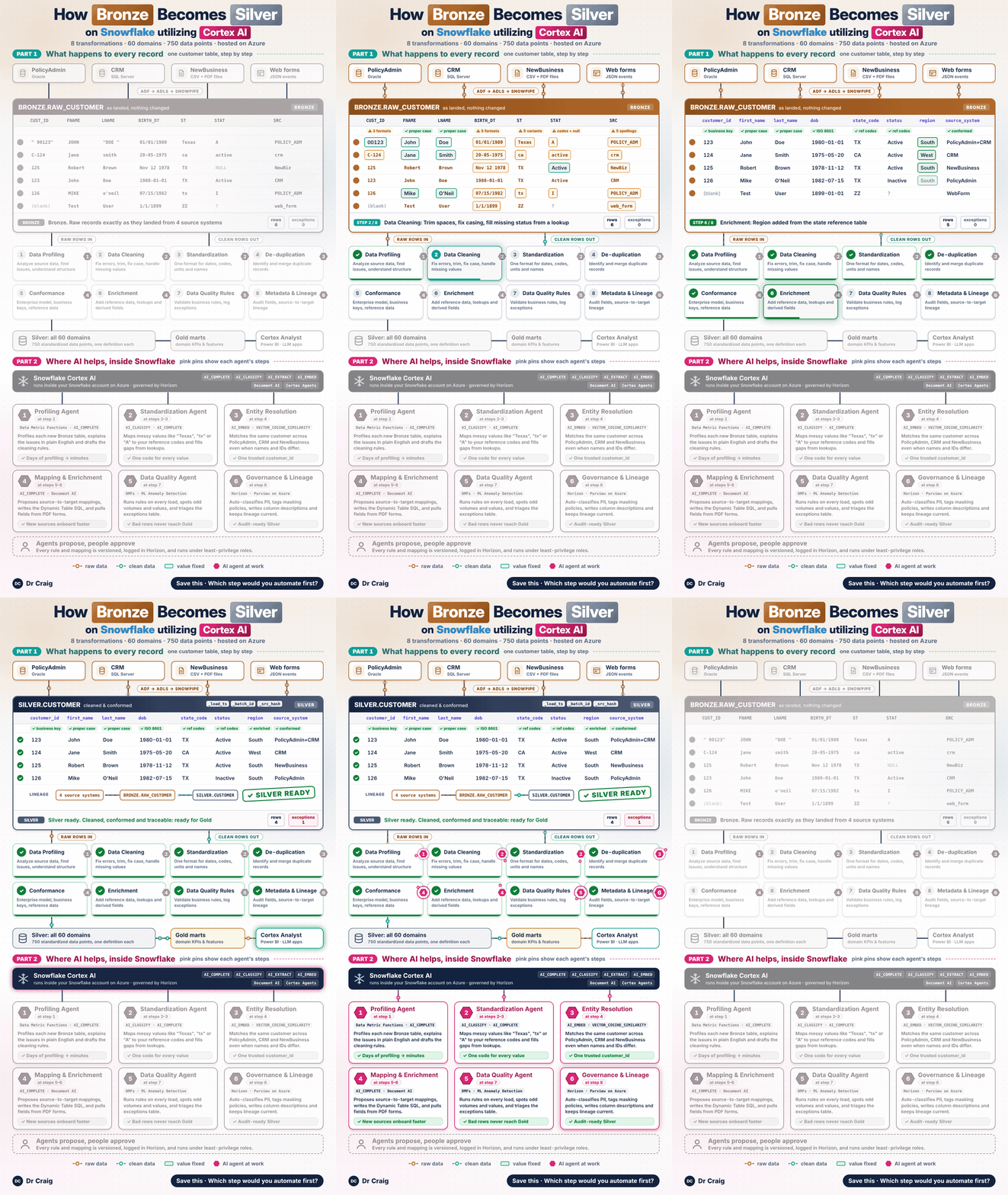
In this insurance-style example, customer records land in Snowflake from four source systems: a policy administration system on Oracle, a CRM on SQL Server, new-business CSV and PDF files, and web form JSON events. Data arrives through Azure Data Factory, ADLS and Snowpipe into a Bronze table exactly as it landed.
The same customer shows up with padded IDs, mixed-case names, five date formats, “Texas”, “TX” and “tx” for the same state, and statuses of “A”, “active” and NULL. No dashboard or AI model can be trusted on top of that.
The process
Eight transformations from Bronze to Silver
- Data profiling: analyze source data, find issues and understand structure.
- Data cleaning: fix errors, trim, fix case and handle missing values.
- Standardization: one format for dates, codes, units and names.
- De-duplication: identify and merge duplicate records.
- Conformance: apply the enterprise model, business keys and reference data.
- Enrichment: add reference data, lookups and derived fields.
- Data quality rules: validate business rules and log exceptions.
- Metadata and lineage: audit fields and source-to-target lineage.
The result: all 60 domains in Silver, 750 standardized data points with one definition each, ready for Gold marts, Cortex Analyst, Power BI and LLM applications.
Agentic AI
Where AI helps, inside Snowflake
Snowflake Cortex AI runs inside the Snowflake account on Azure and is governed by Snowflake Horizon, so data never leaves the platform. Six AI Agents map to the eight steps:
Profiling agent
Uses Data Metric Functions and AI_COMPLETE to profile each new Bronze table, explain issues in plain English and draft cleaning rules. Days of profiling become minutes.
Standardization agent
Uses AI_CLASSIFY and AI_COMPLETE to map messy values like “Texas”, “tx” or “A” to reference codes and fill gaps from lookups.
Entity resolution
Uses AI_EMBED and vector cosine similarity to match the same customer across systems, even when names and IDs differ. One trusted customer ID.
Mapping and enrichment
Uses AI_COMPLETE and Document AI to propose source-to-target mappings, write Dynamic Table SQL and pull fields from PDF forms.
Data quality agent
Runs rules on every load with DMFs and ML anomaly detection, spots odd volumes and values, and triages the exceptions table.
Governance and lineage
Auto-classifies PII, tags masking policies, writes column descriptions and keeps lineage current in Horizon and Microsoft Purview.
Data governance
Agents propose, people approve
Every rule and mapping an AI Agent suggests is versioned, logged in Snowflake Horizon and run under least-privilege roles. Data stewards stay accountable for what reaches Silver, and PII is classified and masked before anyone downstream can query it.
Business value
Why it matters to the business
- New data sources onboard faster, because AI drafts the profiling, mappings and rules.
- One trusted customer record across systems for Customer 360, pricing and service.
- Bad rows never reach Gold, so executives and AI assistants see the same reliable numbers.
- Audit-ready Silver data, with PII classification, masking and lineage built in.
Questions
Frequently asked questions
What is the difference between Bronze and Silver data?
Bronze holds raw records exactly as they landed from source systems. Silver holds the same data after profiling, cleaning, standardization, de-duplication and quality checks, with one definition for each data point.
What is Snowflake Cortex AI?
Snowflake Cortex AI is a set of AI functions and agents that run inside the Snowflake account, such as AI_COMPLETE, AI_CLASSIFY, AI_EXTRACT, AI_EMBED, Document AI and Cortex Agents, governed by Snowflake Horizon.
Can AI Agents do entity resolution?
Yes. Embeddings and vector similarity can match the same customer across systems even when names, spellings and IDs differ, with people approving the merge rules.
Authorship
Original work by Craig Brown, PhD
This animation and guide were created by Craig Brown, PhD, known on social media as Dr Craig. The concept, architecture, AI agent design and written use case are his original work, first published on his LinkedIn and X channels.
You are welcome to share this guide for learning and discussion, with credit. Please keep the “Dr Craig” label on the image and credit it as: Source: Craig Brown, PhD (Dr Craig), craigbrownphd.com, with a link back to this page. For commercial use, republishing or brand partnerships, please contact Craig on LinkedIn.
© 2026 Craig Brown, PhD. All rights reserved.
Get the next guide first
New AI visual guides are posted on LinkedIn and X before they land here.