
AI Visual Guide · Governed AI agents
How AI Agents answer from governed data on Snowflake with Cortex AI and MCP
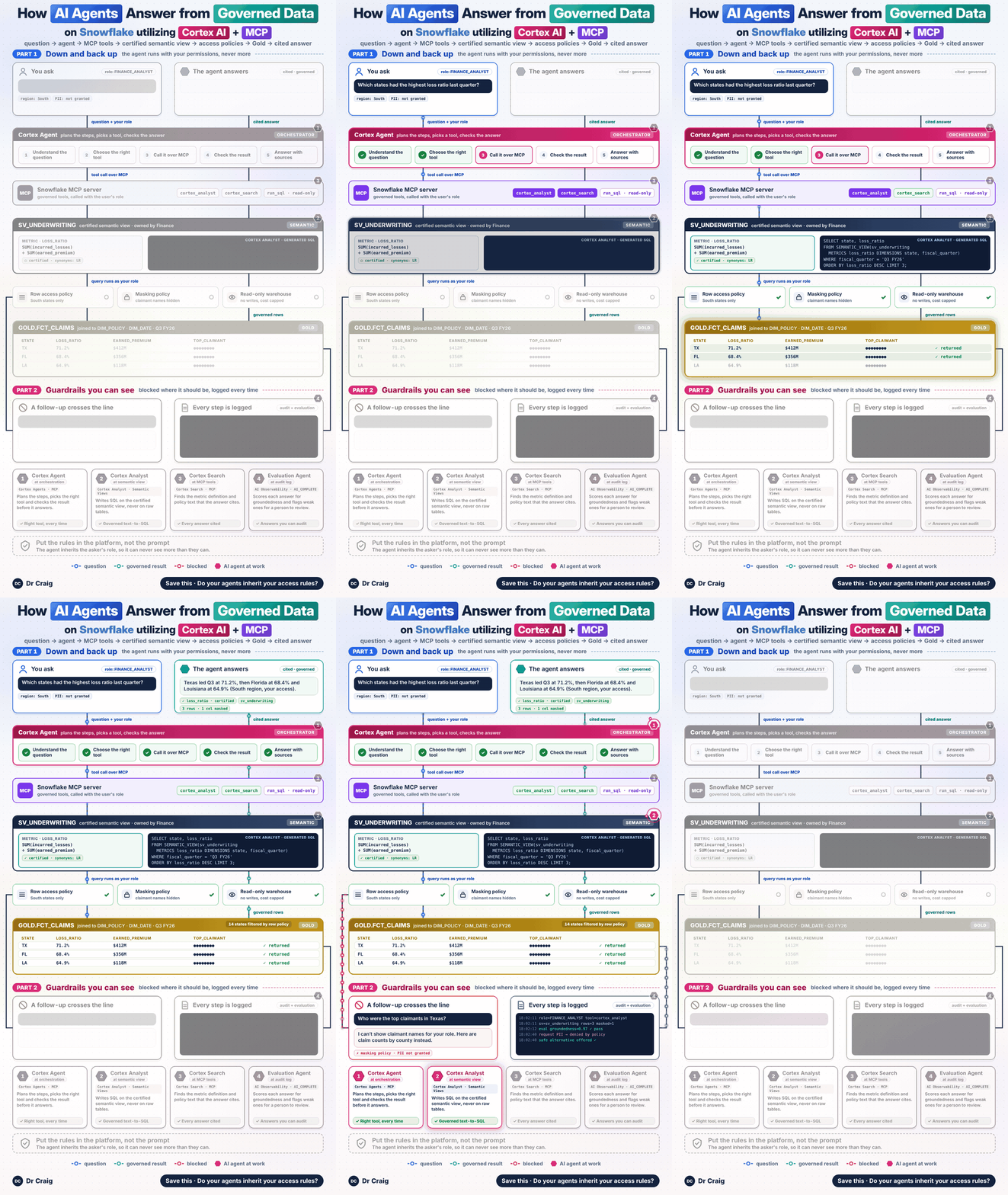
A visual use case for safe Agentic AI: a Cortex Agent calls governed tools over the Model Context Protocol (MCP), queries a certified semantic view under the user’s own role, and returns a cited answer, with every step logged.
The use case
An AI agent that can never see more than you can
Business leaders want to ask an AI agent a question in plain English and get a trustworthy answer. Security and compliance teams worry about the opposite: an agent with broad service-account access that leaks PII, invents numbers or runs unapproved queries.
This guide follows one real-world style question from a finance analyst: “Which states had the highest loss ratio last quarter?” The analyst’s role covers the South region only, and they are not granted PII. The answer comes back in seconds: Texas led Q3 at 71.2%, then Florida at 68.4% and Louisiana at 64.9%, with the certified metric, the semantic view and the masked column all cited.
The process
Part 1: down and back up
- You ask: the question travels with your role, region and PII grants.
- Cortex Agent orchestrates: it understands the question, chooses the right tool, calls it over MCP, checks the result and answers with sources.
- Snowflake MCP server: exposes governed tools such as cortex_analyst, cortex_search and a read-only run_sql, all called with the user’s role, never a super-user.
- Certified semantic view: Cortex Analyst generates SQL against a Finance-owned semantic view where loss ratio is defined once as incurred losses over earned premium.
- Access policies apply: a row access policy limits results to Southern states, a masking policy hides claimant names, and a read-only warehouse blocks writes and caps cost.
- Gold data returns governed rows: the Gold claims fact table returns three rows, with 14 states filtered by policy and one column masked.
Part 2: guardrails you can see
When the analyst follows up with “Who were the top claimants in Texas?”, the masking policy blocks the PII. The agent explains why and offers a safe alternative: claim counts by county. The audit log records the role, tool, semantic view, rows returned, columns masked, a groundedness score of 0.97 and the denied PII request.
Agentic AI
Four AI agents working together
Cortex Agent
The orchestrator. Uses Cortex Agents and MCP to plan the steps, pick the right tool and check the result before it answers. The right tool, every time.
Cortex Analyst
Writes SQL on the certified semantic view, never on raw tables. Governed text-to-SQL that matches the BI dashboard.
Cortex Search
Finds the metric definition and policy text the answer cites, over MCP tools. Every answer is cited.
Evaluation agent
Uses AI Observability and AI_COMPLETE to score each answer for groundedness and flag weak ones for a person to review. Answers you can audit.
Data governance
Put the rules in the platform, not the prompt
Prompt instructions like “do not reveal PII” can be ignored or tricked. Platform controls cannot. In this design the agent inherits the asker’s role, so Snowflake row access policies, dynamic data masking, read-only warehouses and the certified semantic layer decide what the agent can see and do. The Model Context Protocol gives the agent a small set of approved tools instead of open database access.
Every step, from tool call to groundedness score to blocked request, is logged for audit and evaluation. That is what lets risk, compliance and data owners approve AI agents for production.
Business value
Why it matters to the business
- Executives get fast, plain-English answers that match the official dashboards.
- No new security model to build: AI agents reuse the roles, policies and certified metrics already in place.
- Lower risk of PII leaks, hallucinated numbers and runaway query costs.
- Audit-ready Agentic AI, with cited sources, groundedness scores and a complete log of every request.
Questions
Frequently asked questions
What is MCP in AI?
The Model Context Protocol (MCP) is an open standard that lets AI agents call external tools and data sources in a consistent way. A Snowflake MCP server exposes governed tools, such as Cortex Analyst, Cortex Search and read-only SQL, to an AI agent.
How do you stop an AI agent from seeing data it should not?
Run the agent with the asking user’s role, not a shared service account, and enforce access in the data platform with row access policies, masking policies and certified semantic views. The agent can never see more than the person asking.
What is a Cortex Agent?
A Cortex Agent is a Snowflake Cortex AI orchestrator that plans the steps to answer a question, chooses tools such as Cortex Analyst and Cortex Search, checks the result and returns an answer with sources.
How are AI agent answers evaluated?
An evaluation agent scores each answer for groundedness against the data and sources it used, logs the score, and flags weak answers for human review.
Authorship
Original work by Craig Brown, PhD
This animation and guide were created by Craig Brown, PhD, known on social media as Dr Craig. The concept, architecture, AI agent design and written use case are his original work, first published on his LinkedIn and X channels.
You are welcome to share this guide for learning and discussion, with credit. Please keep the “Dr Craig” label on the image and credit it as: Source: Craig Brown, PhD (Dr Craig), craigbrownphd.com, with a link back to this page. For commercial use, republishing or brand partnerships, please contact Craig on LinkedIn.
© 2026 Craig Brown, PhD. All rights reserved.
Get the next guide first
New AI visual guides are posted on LinkedIn and X before they land here.